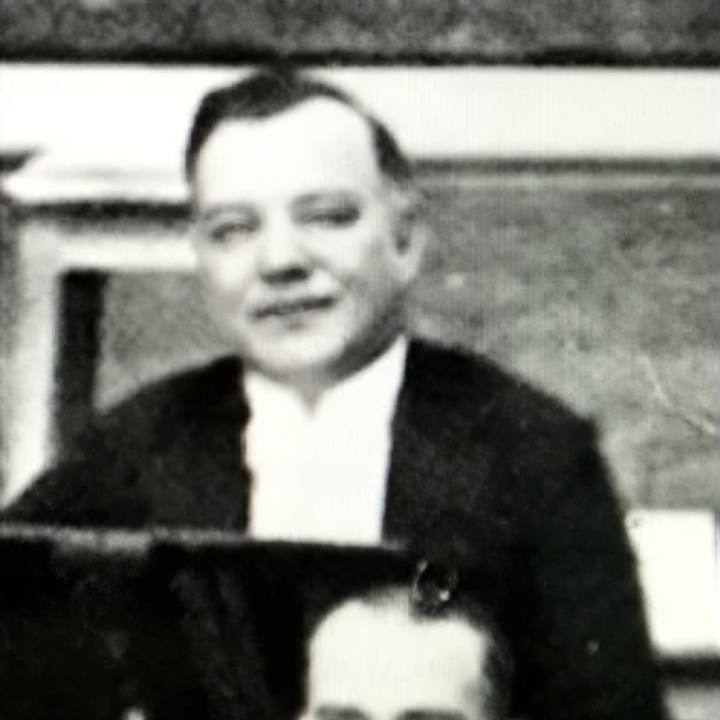
Franz Dengler
Franz Dengler (1890–1963) was principal trumpet of the Vienna Philharmonic Orchestra during one of the most politically fraught periods in European history. While his technical abilities and influence on trumpet pedagogy are well documented, his activities during the Second World War reveal the extent to which prominent musicians became embedded in the Nazi cultural apparatus.
Born in Karlsbad in 1890, Dengler studied at the Dresden Conservatory under the influence of Eduard Seifert, who had performed under Richard Strauss. At Strauss's request, Dengler was appointed principal trumpet of the Berlin Opera Orchestra in 1908. A decade later, in 1918, he moved to the Vienna Court Opera (later the Vienna State Opera) at the suggestion of Franz Schalk. He would serve as principal and solo trumpet for both the State Opera and the Vienna Philharmonic until 1955.
Dengler's appointment at the Vienna Academy of Music came in 1931, and he was made professor the following year. His teaching career would continue until 1959, during which time he trained notable students including Adolf Scherbaum and Helmut Wobisch, who would later succeed him as principal trumpet of the Vienna Philharmonic for thirty-nine years.
Dengler's Nazi Party Membership
On December 2, 1938, Franz Dengler applied for membership in the Nationalsozialistische Deutsche Arbeiterpartei (NSDAP). His application was accepted with retroactive membership to May 1, 1938, shortly after the Anschluss that annexed Austria to Nazi Germany. He was assigned membership number 6,292,822.
Different accounts of Dengler's party membership exist. One source claims his Jewish girlfriend, Marie Grubstein, testified that she had been living underground while Dengler joined the party believing he could keep her safe by becoming a member. However, the timing and circumstances of his membership—applied for months after the Anschluss and granted retroactively—suggest a more complex relationship with the regime than simple protective measures would indicate.
Under Nazi control, the Vienna Philharmonic underwent what the regime termed a "cleansing." Jewish members were immediately dismissed following the 1938 annexation. By the end of the war, six Jewish members of the orchestra had been murdered in concentration camps. The remaining members, including Dengler, were granted "UK-Stellung" (Unabkömmlich, or "Indispensable" status), which exempted them from front-line military service because their artistic contribution to the Reich was deemed more valuable than their service as soldiers.
The Vienna Philharmonic held a unique status as the "cultural jewel" of the newly annexed Austria, known officially as the Ostmark. Gauleiter Baldur von Schirach, the Nazi leader in Vienna, took personal interest in the orchestra, ensuring they received extra rations and funding to maintain their world-class sound as a symbol of the city's Germanic heritage.
The orchestra served multiple propaganda functions: proving German-Austrian cultural superiority, touring occupied territories and neutral countries to project an image of normalcy and refinement during the war, and performing at NSDAP party congresses and state celebrations. As principal trumpeter, Dengler's rotary-valve sound provided the literal soundtrack to many state ceremonies, where the trumpet's inherently heroic character served the regime's needs.
The Trompeterchor der Stadt Wien
Dengler played a central role in the Trompeterchor der Stadt Wien (Trumpet Choir of the City of Vienna), officially designated in 1939. This elite brass ensemble drew primarily from the city's three major orchestras and served both artistic and political purposes. The group performed at the Rathaus (City Hall) for visiting dignitaries and Nazi party events, functioning as a specialized unit for ceremonial and state occasions.
The ensemble's configuration was substantially larger than a standard orchestral brass section, typically including 10–12 trumpets, 7–8 trombones, 2 tubas, and timpani and percussion. This created what was described as a "wall of sound" designed to fill large squares and grand halls with the rich, dark, resonant sound that became synonymous with "Festive Vienna."
As the lead artistic figure of the Trompeterchor, Dengler dictated the phrasing, vibrato, and style that the rest of the trumpet section emulated. The group served as a training ground where he mentored younger players, including Wobisch, ensuring that the specific Viennese school of playing continued even during the war years.
The ensemble's most significant work was Richard Strauss's Festmusik der Stadt Wien (1943), written specifically for the Trompeterchor. The premiere was a deeply political event, conducted by Strauss himself at the Vienna Rathaus as a "gift" to the city council in gratitude for a prize he had received from the Nazi administration. Composer Karl Pilss, who had written his Trumpet Concerto for Dengler in 1934, wrote approximately fifty works for the Trompeterchor, often blending Late Romanticism with the "heroic" aesthetic favoured by the Reichsmusikkammer (Reich Music Chamber).
Repertoire and Aesthetic Alignment
The Vienna Philharmonic's repertoire during the Nazi period was strictly curated to align with National Socialist ideals. This heavily featured what the regime considered the "Great German Masters": Richard Wagner and Anton Bruckner, viewed as the spiritual foundation of the Reich; Richard Strauss, a living legend who worked closely with Dengler and the orchestra; and Beethoven and Brahms, representing the intellectual rigor of German music.
Dengler performed with the Vienna Philharmonic in the Kriegswinterhilfswerk (Winter Relief) concerts and for soldiers on leave, where the orchestra functioned as a morale-boosting mechanism. His specific rotary-valve sound and the Late Romantic, Straussian style he championed perfectly matched the "Heroic-Germanic" aesthetic promoted by the regime.
Dengler was a primary architect of what became known as the "Vienna trumpet sound," a style that favours a darker, more vocal quality compared to the brighter sound of American or French schools. The cornerstone of this sound is the rotary valve trumpet (specifically in C or B-flat), which allows for smoother, more fluid connections between notes than the piston valves found on standard modern trumpets.
Viennese trumpets typically feature a larger bore and a thinner, larger bell, producing a rich, warm tone that blends seamlessly with woodwinds and horns rather than sitting on top of the orchestral texture. Dengler emphasized a heavy, singing vibrato and a broad, noble approach to phrasing, largely influenced by the Late Romantic works of Richard Strauss and Anton Bruckner, where the trumpet often takes on a heroic, vocal role.
At the time Dengler performed, the Heckle rotary trumpet was the instrument of choice, capable of what was described as a tone with "golden clarity unmatched by any other B-flat trumpet." While the rotary trumpet possesses a beautiful sound, it is not capable of the volume, brilliance, and power of modern piston valve instruments—a consideration Karl Pilss must have had in mind when he dedicated his 1934 Concerto to Dengler, emphasizing singing sound and effortless legato style rather than power and brilliance.
From a wall of sound to a wall of silence
Following the end of the war, Dengler was relieved of his duties at the School of Music Vienna on June 13, 1945. However, he was cleared by the Commission on Denazification on December 3, 1945. Despite his party membership, Dengler was not permanently ousted during the de-Nazification process. Because of his technical skill and the difficulty of replacing a principal player of his caliber, he was eventually "rehabilitated" and allowed to continue his career. He remained a central figure in the Vienna Philharmonic until his retirement in 1955.
In 1960, he received the Austrian Cross of Honour for Science and Art, a state recognition of his contributions to music and education.
The Trompeterchor der Stadt Wien was largely disbanded in its official capacity after 1945 due to its heavy associations with the Nazi regime, though the tradition lived on through various iterations of Vienna brass ensembles. For decades after 1945, the Vienna Philharmonic maintained what has been described as a "wall of silence" regarding its activities as a Reich-designated orchestra. The orchestra did not fully open its archives until the late twentieth and early twenty-first centuries, when the extent of party membership among its ranks—including Dengler's—was revealed.
Franz Dengler's career illustrates the complex position of prominent musicians in the Third Reich. His membership in the Nazi Party, his role in the Vienna Philharmonic during its service as a Reich-designated orchestra, and his leadership of the Trompeterchor der Stadt Wien demonstrate how thoroughly the regime integrated high-profile cultural figures into its propaganda apparatus.
The survival of his career through the de-Nazification process and his subsequent honours reflect both the practical difficulties of replacing world-class musicians and the post-war Austrian cultural establishment's willingness to rehabilitate those whose technical contributions were deemed valuable. The decades-long silence maintained by the Vienna Philharmonic about the orchestra's wartime activities suggests an institutional reluctance to confront this history directly.
Dengler's influence on trumpet playing remains through the Vienna sound he helped establish and the students he trained. The style he championed continues in the Vienna Philharmonic, though now separated from the political context in which it was developed and promoted during the years 1938–1945.
Sources
Vienna Philharmonic Orchestra Archives
Austrian State Archives (Österreichisches Staatsarchiv)
Documentation of Nazi Party membership records
Latimer, F. Mark. Musicians Lost and Found (https://www.musicianslostandfound.org/ accessed February 2026)
Adler, J. (2009). Expanding the Trumpet Repertoire: A Pedagogical Exploration of Four Diverse Works for Trumpet by Bertold Hummel, James Miley, Karl Pilss, and Joseph Turrin [University of Miami].