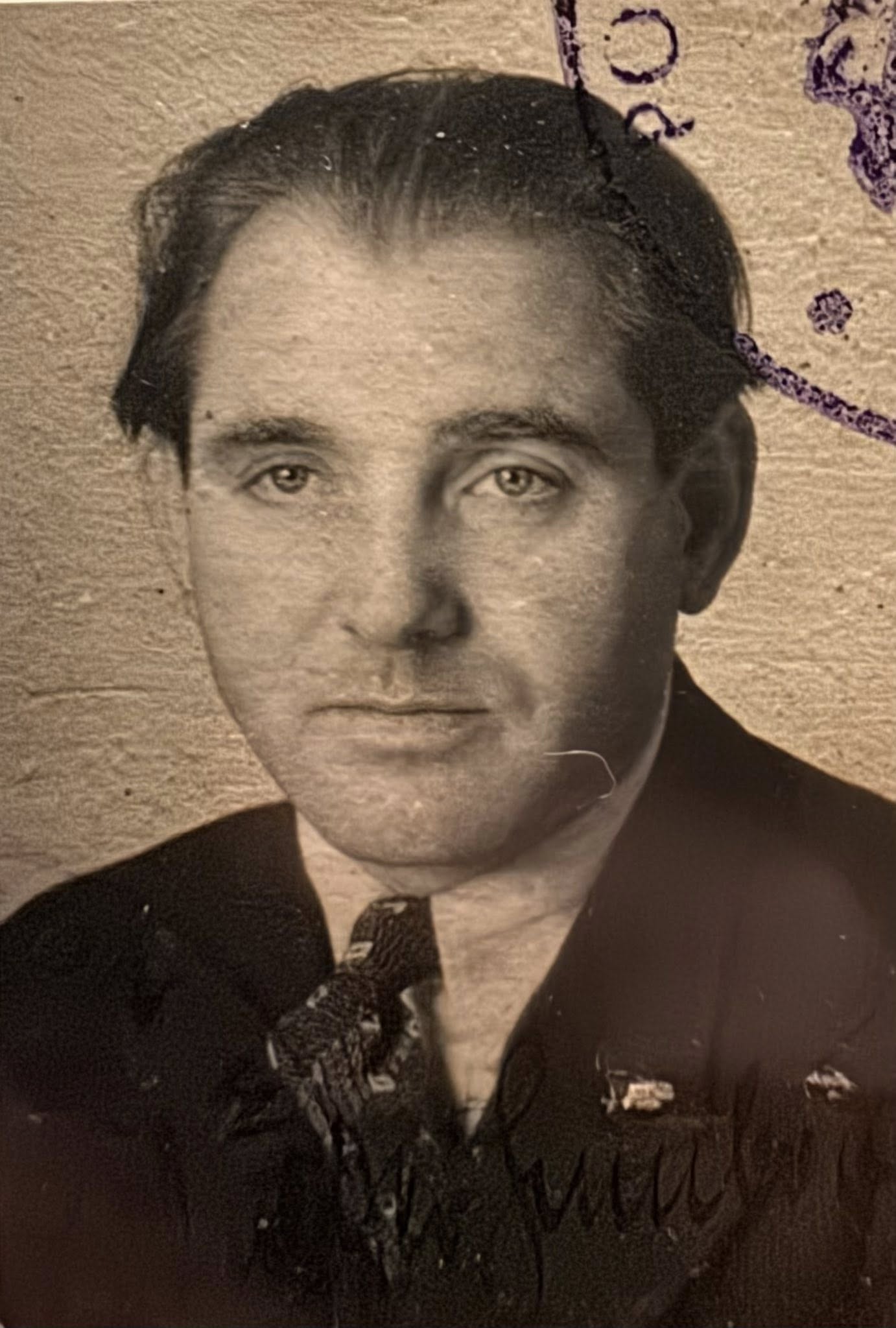
Walter Hamböck
The Fall and Survival of Hitler's Pianist
Walter Hamböck was born in Vienna in 1910 and showed exceptional musical ability from childhood. By age ten, he was playing the organ in cinemas, providing the soundtrack for silent films. By his twenties, he had become a professor of music and accomplished concert pianist. In 1932, he placed third in an international competition to find the world's best pianist, winning a grand piano as his prize. His particular skill in interpreting Beethoven's works brought him recognition across Europe.
In 1936, Hamböck's career took an unusual turn when Joseph Goebbels and Hermann Göering attended one of his recitals at the Kaiserhof hotel in Berlin. The two senior Nazi officials introduced him to Adolf Hitler, who appointed Hamböck as his personal pianist. For the next several years, Hamböck was required to perform whenever the Führer requested, often forcing him to cancel other engagements. He served as Hitler's personal pianist for five years.
Hitler, though lacking formal musical training, appeared to appreciate Hamböck's playing, particularly his performances of Beethoven. In 1938, at the Reich Chancellery, Hitler personally presented Hamböck with a diploma conferring an honorary professorship for services to the Reich. Hitler also gave him a signed copy of Mein Kampf with the inscription "To my young pianist friend."
Hamböck also developed connections with other high-ranking Nazis. He introduced Hermann Göering to Emmy Sonnemann, an actress, who became Göering's wife. Hamböck played the organ at their wedding. Emmy Sonnemann later became known as the "First Lady of the Reich."
Arrest and Imprisonment
In early 1940, Hambock accepted an invitation to perform a Liszt Piano Concerto before Queen Wilhelmina at The Hague in Holland. The conductor was Jewish, though his identity remains unclear in the historical record. Whoever it was, Hamböck's decision to perform with a Jewish conductor proved catastrophic.
Upon his return journey at Aachen, the Gestapo arrested Hamböck and brought him to Berlin. There, Martin Bormann, Hitler's private secretary and one of his most feared officials, confronted him. According to Hamböck's later account, Bormann pointed a pistol at him and shouted: "You play for our Führer and then you play for a Jew!" Though Bormann was restrained from shooting him on the spot, Hamböck was sent to Dachau concentration camp, marked as politically unreliable by the red patch on his striped prison uniform.
After several weeks, he was transferred to Flossenbürg concentration camp in Bavaria, where approximately 30,000 prisoners died from execution, starvation, or forced labour.
At Flossenbürg, the camp commander recognized Hamböck's musical abilities and appointed him conductor and organizer of the camp orchestra. This assignment carried a grim responsibility: the orchestra played as thousands of prisoners marched to their deaths.
However, Hamböck used his position to save lives where possible. Under camp rules, any prisoner who missed roll call for more than three days due to illness was executed. When his friend Ferdinand Sterz became sick and reached his third day of absence, Hamböck devised a plan. He wrote: "I kept talking to him, pulled him up, and half-dragged, half-carried him to the orchestra. There, I placed him on a chair, put a violin in his hand and told him to pull the bow across silently, but as though he were playing. Thus, at inspection-time, Ferdinand Sterz was accounted for." Sterz survived.
Hamböck spent five years imprisoned in the concentration camps.
Escape
In April 1945, as American forces approached and the war neared its end, orders came to execute all remaining prisoners. The camp commander, who shared Hamböck's appreciation for Beethoven's music, gave him a German SS officer's uniform. On 20 April 1945, Hamböck grabbed a torn brown blanket, which he kept for the rest of his life, and walked out through the main gates unchallenged.
Exhausted and suffering from double pneumonia, he travelled nearly 200 miles across Bavaria, relying on strangers' assistance, until he reached the home of a tenor singer friend. After recovering, he eventually made his way to Vienna and his former home. When he knocked on the door, a stranger wearing his clothes answered. His wife, convinced of his death during his five years of captivity, had divorced him and remarried.
Some years after the war, Hamböck met Helen Weir, a Scottish languages teacher, in Berlin. He followed her to Scotland and proposed to her at her home in Airdrie on Good Friday 1962. When she went upstairs to consider his proposal, he sat at the piano and played Beethoven's Moonlight Sonata and Pathétique Sonata. She came downstairs and accepted.
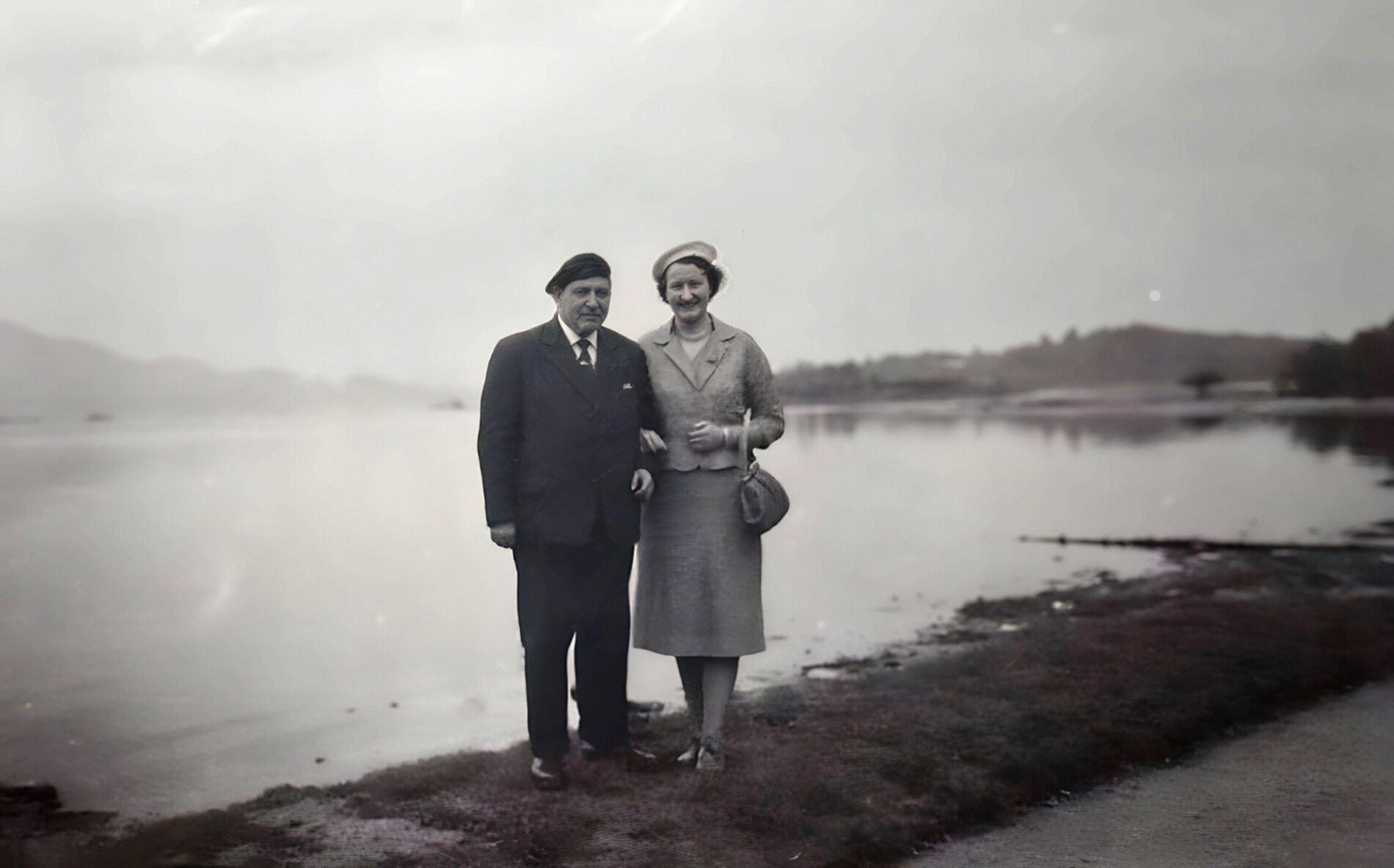
Walter Hambock avec son épouse Helen Wier au Loch Lomond en 1962.
They married that year and settled in Strichen, Aberdeenshire, where Hamböck took the position of organist at the parish church for £48 per year. The job came with accommodation in the manse. The couple transported the grand piano Hamböck had won thirty years earlier from Vienna to Scotland—the only piece of furniture they brought with them. That the piano had survived the war years, Hamböck's imprisonment, and his wife's remarriage during his absence, and could now begin a new life with him in Scotland, seemed remarkable.
In Strichen, Hamböck played the organ at Sunday services, directed the local musical society, and ran a small sheet-music publishing business called the Austro-Scotia Music Company. Few in the village knew about his past. The Fraserburgh Herald noted that he "now spends many evenings in the solitude of Strichen Parish Church playing the organ with the memories of Nazism and concentration camps far in the background."
In the late 1960s, the Hamböcks moved to Motherwell in Scotland, where Walter gave piano lessons. Among his students was "Wee" Neil Reid, who later became a singing sensation and the youngest singer to have a number one album in the UK charts.
Hamböck died in hospital in 1979 at age 70 and was buried in Airdrie. He left no children but did leave behind memoirs titled "Music Saved My Life," written in both German and English.
In his writings, Hamböck maintained that his decision to perform with the Jewish conductor had been correct, despite the consequences. He wrote:
"My love of music blinded me to any danger. I did not debate, for a minute, if the conductor were Jewish and, even if I had known that such was the case, I would still have gone… I had the chance to play at a good concert, and always as an artiste, a musician first and foremost, I simply went off and played."
In his memoir, Hamböck recounts his acquaintance with Horst Wessel, a German man who became a Nazi martyr when he was murdered by two communists in 1930. The march for which Wessel wrote the lyrics was renamed the 'Horst-Wessel-Lied' ('Horst Wessel Song'), and became the Nazi Party's official anthem.
Among the possessions in his Scottish home were two items from vastly different periods of his life: the grand piano he'd won in 1932, and the torn brown blanket he had grabbed during his escape from Flossenbürg on 20 April 1945.
Sources
BBC News. "The remarkable story of 'Hitler's pianist' in Scotland." Accessed from provided documents.
Daily Mirror. "'Hitler's pianist' escaped from Nazi Germany to live out life in UK countryside." December 2025.
The Telegraph. "The life of 'Hitler's pianist' after he fled Nazi Germany for quiet life in Aberdeenshire." December 2025.
Fraserburgh Herald. Historical archives, 1960s-1970s. Referenced in provided documents.
Helen Duncan and Tobiasz Siotor continue to research Walter Hamböck and intend to publish a comprehensive text on his life. For more information: https://www.facebook.com/profile.php?id=61583246759970