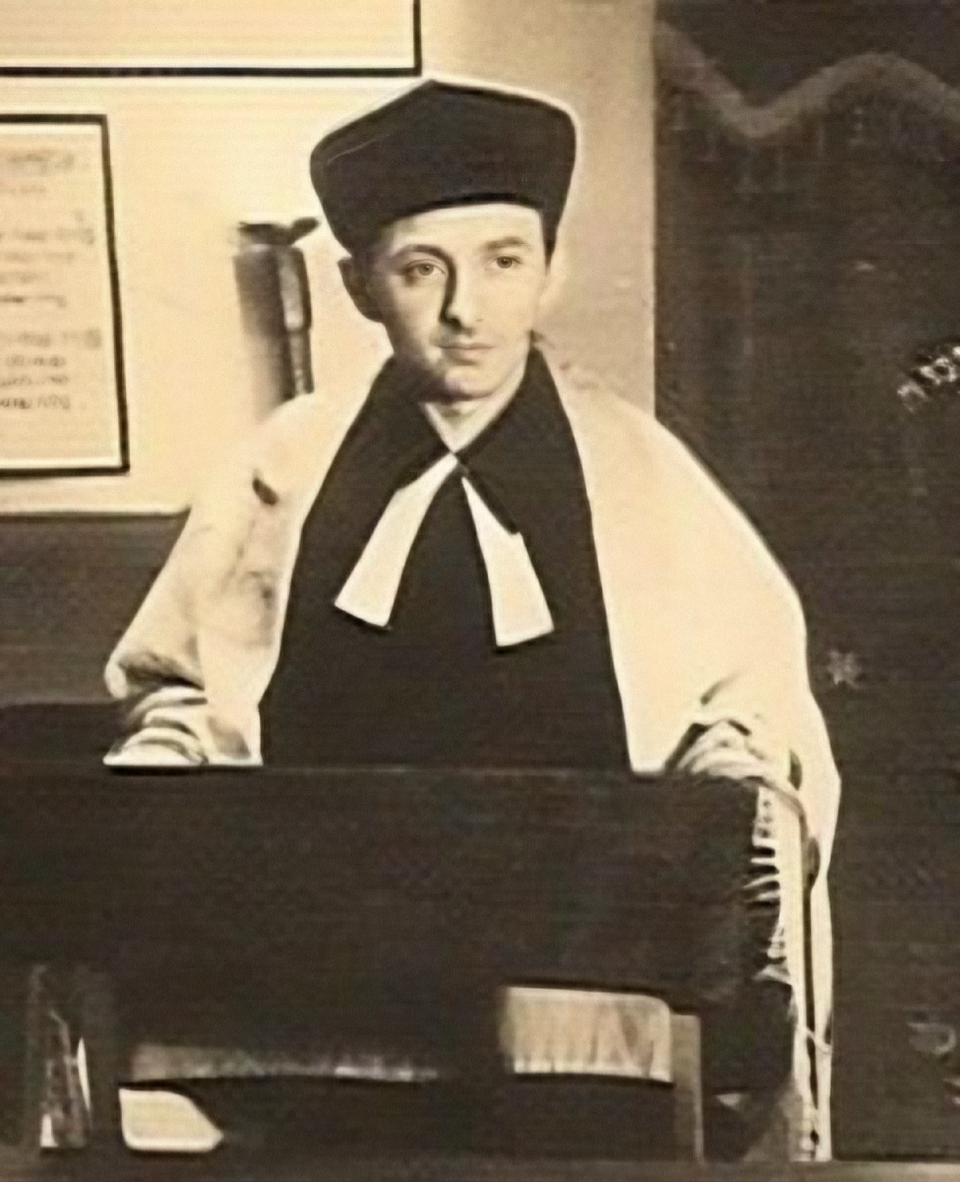
Leopold Fleischer
Leopold Fleischer was a German-Jewish cantor who left Germany in June 1939, a few weeks after his wedding, and spent the next eight and a half years as a refugee in Shanghai, one of the few places in the world that still admitted Jews without a visa. The family's escape was organised by his mother-in-law, Martha Frankenstein, who sold the family business to pay for the passage and then used the tickets to obtain her husband's release from Sachsenhausen concentration camp. In Shanghai, Fleischer led services in several synagogues of the refugee community and taught Hebrew to children, while trying, through letters and appeals, to bring his own parents and sister out of Germany. He did not succeed, and all three were deported and murdered at Auschwitz. After the war he waited three years for permission to enter the United States, and from 1955 served for more than twenty years as cantor of a Chicago congregation founded by refugees from Nazi Germany.
Fleischer was born on 3 December 1910 in Hindenburg, Upper Silesia (now Zabrze in Poland), the son of Ernst and Freda Fleischer; he had a sister, Margot. He attended a cantorial school and a seminary in Germany, where he also qualified as a teacher. In January 1937 he moved to Swinemünde, a resort town on the Baltic coast, to take up a post as the town's cantor. He rented a room in a building owned by Julius and Martha Frankenstein, who ran a fabric and dressmaking shop there with two seamstresses and lived above the premises. Julius, born in Berlin in 1889, had fought and been wounded in the First World War. Fleischer fell in love with their daughter, Carla, born in Swinemünde on 24 October 1920.
The Nuremberg Laws of 1935 had already excluded Jews from German civil society, but for the Frankensteins life in Swinemünde did not change sharply until November 1938. In the days after Kristallnacht, SS men went from door to door arresting Jewish men. Julius Frankenstein was taken to Sachsenhausen, where he was held for about six weeks. Fleischer was not at home when the arrests were made and escaped detention.
Leaving Germany
Martha Frankenstein decided at once that the family had to leave, but few countries would accept Jewish immigrants. Shanghai was an exception. Parts of the city had been under Japanese occupation since 1937, there was no effective passport control at the port, and until August 1939 no visa was needed to land there. The refugee population grew from around 1,500 at the end of 1938 to nearly 17,000 a year later. The obstacle was cost: most ships on the route were passenger liners, fares were high, and emigrants' savings were frozen in Germany. Martha sold the house, the shop and some furnishings to a non-Jewish neighbour at a fraction of their value and raised enough to buy five tickets on the Norddeutscher Lloyd line. She obtained exit papers from the mayor's office in Swinemünde, then went to the Gestapo with the papers and the tickets. Her daughter, Judy Fleischer Kolb, later described what she told them:
"Here are our exit papers; here are the tickets. This proves we are leaving and you need to let my husband out of the camp."
Julius was released soon afterwards.
Leopold and Carla were married on 30 May 1939. He was 28 and she was 18. Each emigrant was permitted to take ten Reichsmarks, then worth about four US dollars, together with clothing and some furniture. Everything packed for shipment was inspected by the Gestapo. Carla's brother Heinz, then sixteen, later recalled his fear during the inspection, because his mother had hidden some jewellery in one of the steamer trunks; it was not found. Fleischer tried to persuade his own parents to come to Shanghai with them. They had heard bad reports of the city and hoped to emigrate elsewhere, possibly to the United States, and stayed behind.
In early June 1939 the five of them sailed from Bremerhaven: Julius, Martha, Heinz, Leopold and Carla. The liner, which Kolb names as the Gneisenau, passed through the Strait of Gibraltar to Italy, crossed the Mediterranean to the Suez Canal and continued by way of India, Manila and Hong Kong. The voyage of roughly 8,000 miles took four weeks, and Fleischer's obituary records that it served as the couple's honeymoon. They reached the port on the Huangpu, a tributary of the Yangtze, in July 1939. A few weeks later, in August, the Shanghai authorities began to restrict the entry of further European refugees.
Hongkew
Residents of the existing Jewish communities met new arrivals at the docks with open-backed trucks. The family was first taken to a Heim (German for "home"), one of the converted barracks in which refugees slept in rows of narrow bunks, and then found rooms at 343 Ward Road. Like most refugees without outside funds, they lived in Hongkew, the poorest district of the city, partly destroyed in the fighting between China and Japan in 1937. Their daughter, Judith, known as Daisy, was born on 6 March 1940, after which the family moved to three rooms at 83 Wayside Road. Leopold and Carla had a small bedroom; Daisy slept in the third room with her grandparents, which also served as an office.
The family supported itself through its own businesses. Julius and Martha joined Mr Levin, an acquaintance from Potsdam, in a carting firm that they later took over and ran as Star Transportation, moving sacks of rice and other goods on handcarts pulled by hired Chinese labourers, to whom Martha taught some German. Heinz opened a bakery, the Daisy Café, and later a larger shop.
Fleischer worked as a cantor. He conducted services in various synagogues in the refugee district, taught Hebrew and prepared boys for their bar mitzvah, and with other refugee cantors in the city formed a committee that organised activities for the community. In the evenings he taught his daughter to read Hebrew; she never learned to read German, her first language, and was taught in English once she started school at the refugee school funded by Sir Horace Kadoorie. She later described his lessons as strict, and his singing as the centre of her religious life:
"My father was a cantor. His life was his religion... I always say my religion was listening to my father sing. That was my pride in going to temple was to listen to my father sing."
Conditions in Hongkew were hard. Summers were hot and humid and winters cold and wet. Most living quarters had no toilets, and households used chamber pots that were emptied each morning. Drinking water had to be boiled, and fruit and vegetables were washed in boiling water before they could be eaten. Rats, cockroaches, lice and bedbugs were common, and diarrhoea and dysentery spread easily. Martha contracted dysentery and Daisy had whooping cough and intestinal worms; there were refugee doctors and a hospital, but medical supplies were scarce. The refugees nevertheless built a full cultural life in the district, with newspapers, cafés, theatres, cabarets and concerts, and with synagogue services led by cantors such as Fleischer.
War and the Designated Area
The Japanese attack on Pearl Harbor on 7 December 1941 cut Shanghai off from the United States. Money from American Jewish charities stopped arriving, contact with America was banned and inflation rose. In 1942 Josef Meisinger, the Gestapo officer attached to the German embassy in Tokyo, who had earlier served in occupied Warsaw and was known as the "Butcher of Warsaw", came to Shanghai. Kolb recounts the rumours that circulated among the refugees about German proposals to the Japanese authorities to dispose of the Jewish population, but the Japanese did not adopt them. On 18 February 1943, however, they proclaimed a "Designated Area for Stateless Refugees" in Hongkew, and all refugees who had arrived after 1937 were required to move into it by 18 May. The proclamation did not mention Jews. Because the Fleischers already lived in Hongkew they did not have to move, but the area became much more crowded.
The district was not walled or fenced, but it was patrolled and subject to a curfew, and anyone who needed to leave it required a pass. Passes were issued by the Japanese official Kanoh Ghoya, who called himself "King of the Jews" and was known for shouting at and striking applicants. Julius Frankenstein, whose carting work took him outside the area, was once arrested over incorrectly completed transport papers and held for several days in Bridge House, the Japanese military police prison, until the man who had hired him admitted responsibility. Heinz cycled to the prison each day with food and clean clothes.
Throughout these years Fleischer tried to get his parents and his sister out of Germany. He appealed to the immigration department in Shanghai and wrote to distant relatives and organisations in the United States asking for help. His mother wrote to him regularly until 1942, when her letters stopped. Ernst, Freda and Margot Fleischer were deported to Auschwitz and murdered. Martha Frankenstein's sister Betty and her husband were also killed. Kolb has said that she was never aware of her father's distress as a child, and that she could not bring herself to raise the subject with him as an adult:
"I can't imagine the anguish my father must have felt trying to get his parents and sister out of Germany. It is even harder to imagine the sadness when he learned that they had been murdered in such a brutal way."
In 1945 American bombers flew over Shanghai and the air-raid sirens sounded frequently. On 17 July 1945 bombs fell on Hongkew. Kolb gives the casualties as 38 refugees, around 300 Japanese and about 4,000 Chinese; other accounts put the number of refugees killed at 31. Wayside Road was undamaged. After Japan surrendered in August 1945 the Japanese guards left the district, but conditions changed little at first, and there was a period of food shortage before American aid and care packages resumed. In 1946 Heinz Frankenstein was married in a synagogue in Hongkew.
Emigration and Chicago
Almost none of the European refugees intended to stay in Shanghai. The Fleischers wanted to go to the United States, which admitted immigrants under national quotas, and they were given a quota number and waited. Applicants needed exit papers, entry papers and a sponsor, either a relative or an organisation, willing to support them if they could not find work. Their status made the paperwork harder: the German government had stripped them of their citizenship, and Daisy's birth in China had not made her Chinese, so she travelled on a United Nations certificate of identity issued in place of a passport. In 1948 Fleischer obtained a character reference from Rabbi Meir Ashkenazi, chief rabbi of Shanghai's Russian Jewish community. Records of the Far Eastern Jewish Central Information Bureau (DALJEWCIB) from the end of 1947, which include lists of emigrants leaving on the Marine Adder and the General Meigs, list Leopold, Carla and Daisy Fleischer. The family was sponsored by the American Jewish Joint Distribution Committee, and on 8 January 1948 they boarded the transport ship Marine Adder for San Francisco. The crossing, with stops in the Philippines and Hawaii, took about four weeks. On arrival Daisy was quarantined on suspicion of tuberculosis, which proved unfounded.
In San Francisco eight members of the family, including Heinz's new wife and her parents, bought a house together on 29th Avenue. Fleischer was hired as cantor by a local temple, while Carla, Martha and Julius found work at Levi Strauss. The family became American citizens in 1953. In 1955 Fleischer was appointed cantor and teacher at the Habonim Jewish Center in Hyde Park, Chicago, a congregation founded by German-Jewish refugees, succeeding the cantors Ludwig Rosenbusch and Mendell Lewkowitz. The congregation had a volunteer choir directed by Max Janowski, which continued until 1959, and in 1948 had introduced a Kristallnacht Memorial Service. The congregation moved to South Shore in 1957, and in 1973 merged with Ezra Congregation to form Congregation Ezra Habonim, where Fleischer remained as cantor until he was named cantor emeritus in 1976. He kept in contact with other former Shanghai refugees and attended at least one of their reunions in San Francisco.
Leopold Fleischer died on 3 June 1995, aged 84, at his daughter's home. Carla died six months later. Their daughter, Judy Kolb, gave the family's documents, photographs and the red woollen dress that Martha had knitted for her in Shanghai to the Illinois Holocaust Museum and Education Centre, where she became a volunteer and speaker when it opened in 2009.
Sources
Altman, Avraham, and Irene Eber. 'Flight to Shanghai, 1938–1940: The Larger Setting'. Yad Vashem Studies 28 (2000). www.yadvashem.org/articles/academic/flight-to-shanghai-the-larger-setting.html (accessed 16 November 2026).
Central Archives for the History of the Jewish People. 'Outgoing Letters and Cables', Far Eastern Jewish Central Information Bureau (DALJEWCIB) administration files, DAL/140. National Library of Israel. www.nli.org.il/en/archives/NNL_CAHJP990041802040205171/NLI (accessed 16 November 2026).
Chicago Tribune. 'Ex-refugees' Shanghai Surprise'. 8 September 2008. www.chicagotribune.com/2008/09/08/ex-refugees-shanghai-surprise/ (accessed 16 November 2026).
Chicago Tribune. Obituary of Leopold Fleischer. 1994.
eJewishPhilanthropy. 'The Liberation of the Shanghai Jewish Ghetto'. ejewishphilanthropy.com/the-liberation-of-the-shanghai-jewish-ghetto/ (accessed 16 November 2026).
Ezra Habonim, the Niles Township Jewish Congregation. 'History of Ezra Habonim'. www.ehnt.org/history-of-ezra-habonim.html (accessed 16 November 2026).
Illinois Holocaust Museum and Education Center. 'Coffee with a Survivor: Second Generation Speaker Judy Fleischer Kolb'. YouTube. www.youtube.com/watch (accessed 16 November 2026).
Illinois Holocaust Museum and Education Center and Studio C Chicago. 'Judy Kolb'. Resistance, Resilience and Hope: Holocaust Survivor Stories [podcast transcript]. www.studiocchicago.com/judy-kolb-transcript (accessed 16 November 2026).
McGreevy, Nora. 'How Holocaust Survivors Found Refuge in Shanghai, Told Through Stories and Photos'. Smithsonian Magazine, 2021. www.smithsonianmag.com/smart-news/how-holocaust-survivors-found-refuge-shanghai-told-through-stories-and-photos-180978235/ (accessed 16 November 2026).
Tang Yating. The Sound of Exile: European Jewish Refugees in Shanghai, 1938–1947. Syracuse: Syracuse University Press, 2025.
United States Holocaust Memorial Museum. 'German and Austrian Jewish Refugees in Shanghai'. Holocaust Encyclopedia. encyclopedia.ushmm.org/content/en/article/german-and-austrian-jewish-refugees-in-shanghai (accessed 16 November 2026).
United States Holocaust Memorial Museum. 'Proclamation of Restricted Zone in Shanghai for Refugees'. Holocaust Encyclopedia. encyclopedia.ushmm.org/content/en/document/proclamation-of-restricted-zone-in-shanghai-for-refugees (accessed 16 November 2026).